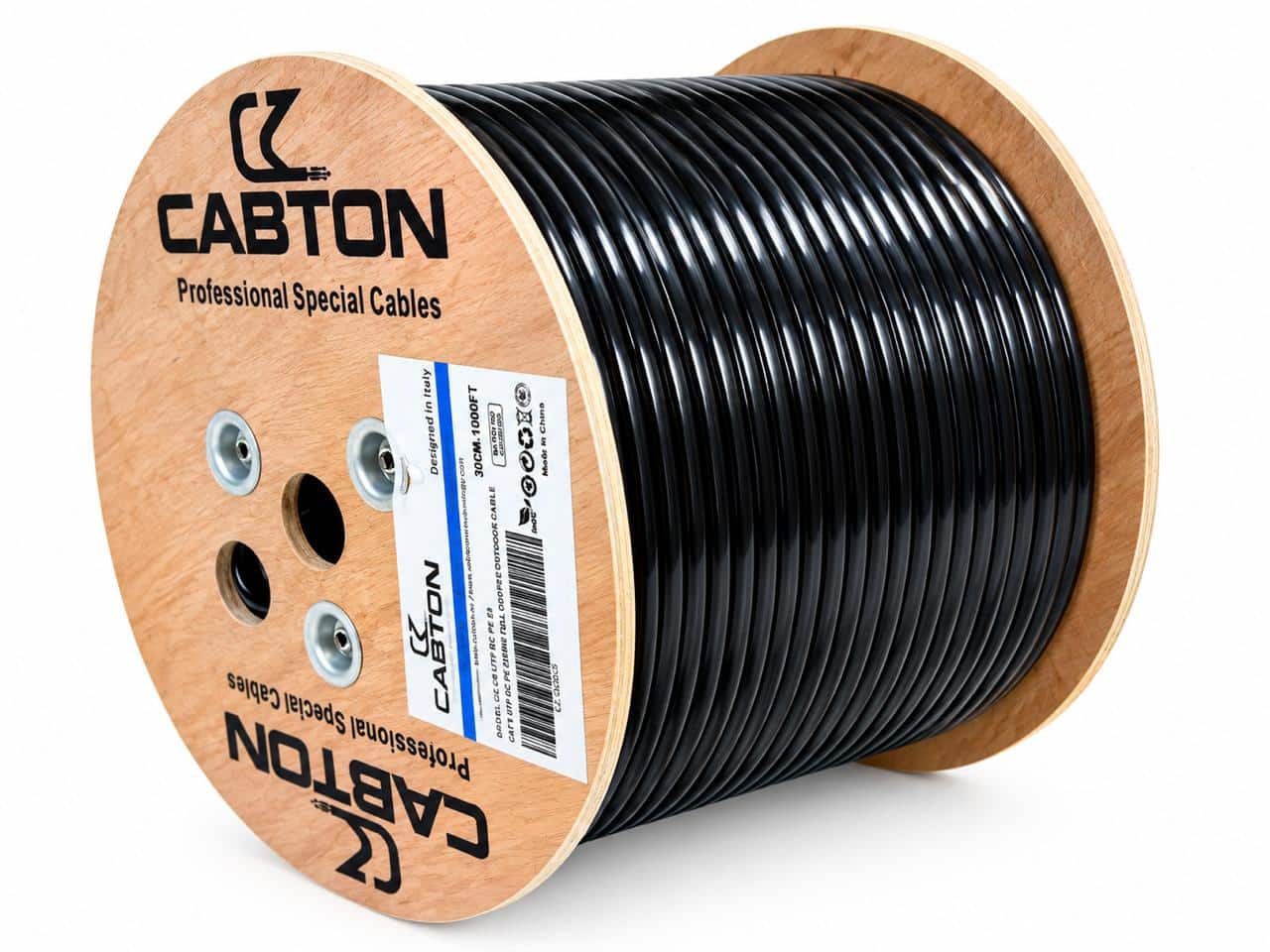
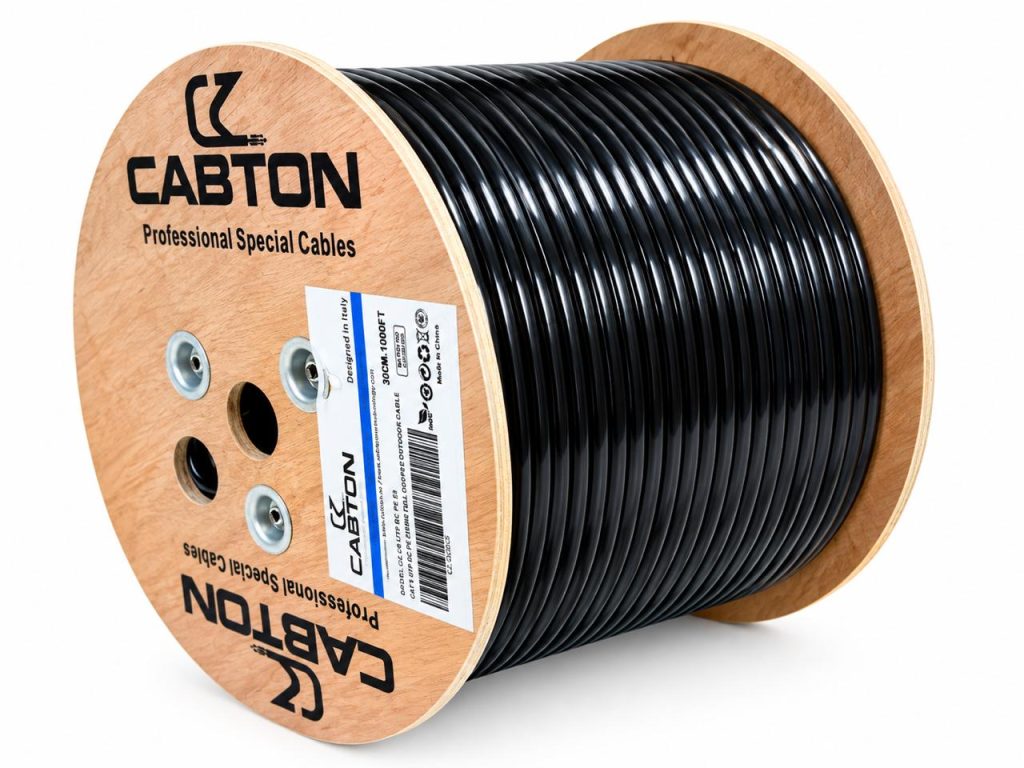
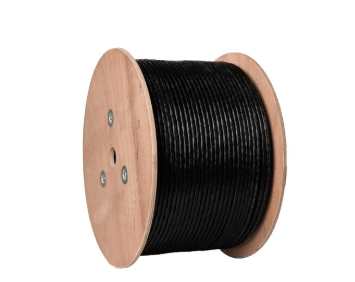
CABTON outdoor CAT6 cable, part number CZ C6 UTP BC PE 23, is a four-pair Category 6 UTP cable built with 23 AWG solid bare copper conductors and a UV-protected black polyethylene jacket for installation outside the building envelope. It is designed for extending LAN connectivity between buildings and across outdoor environments, whether run in conduit or exposed to open conditions. Cable Zone Technology stocks CABTON outdoor CAT6 in 305 metre drums in Dubai. This guide sets out the full CABTON specification and the decisions that determine whether an outdoor link certifies on handover and still certifies five years later.
What CABTON Outdoor CAT6 Cable Is Built From
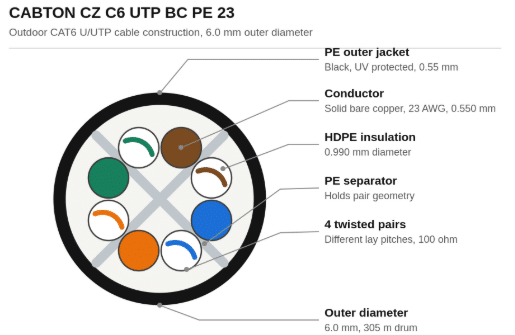
CABTON outdoor CAT6 is built from solid bare electrolytic grade copper conductors, high density polyethylene insulation and a UV-protected PE outer jacket.
The conductor is solid bare electrolytic grade copper at 23 AWG, 0.550 mm ± 0.05 mm. Each conductor is insulated with high density polyethylene to an insulation diameter of 0.990 mm ± 0.05 mm. The eight conductors are arranged as four twisted pairs, laid up with different pitches so that adjacent pairs do not couple into each other.
The pair colour code follows the standard convention: white-blue with blue, white-orange with orange, white-green with green, and white-brown with brown. A polyethylene separator runs through the core, holding the pairs apart and stabilising the geometry that produces the crosstalk performance.
The outer jacket is black UV-protected polyethylene at 0.55 mm ± 0.05 mm thickness, over a finished outer diameter of 6.0 mm ± 0.3 mm. Every drum is sheath-printed with the full identification: CABTON-CZ-C6 UTP BC PE 23/UTP 4PR 23AWG FULL COPPER OUTDOOR ROHS EIA/TIA-568-C2 STANDARD ISO/IEC-11801, followed by the batch number and sequential metre marks from 001M to 305M.
That sheath print matters on site. An installer can identify the cable and confirm it is the specified CABTON product without reference to paperwork, and the metre marking lets a site engineer read off remaining drum length or confirm an installed run length directly.
Why the CABTON PE Jacket Handles Gulf Sunlight
CABTON specifies a UV-protected polyethylene jacket because polyethylene holds its mechanical and dielectric properties under sustained ultraviolet exposure, while the PVC and LSZH jackets used on indoor CAT6 do not.
PVC relies on plasticisers to stay flexible. Heat and UV drive those plasticisers out of the compound. The jacket hardens, crazes, then cracks along bend points. Once the jacket splits, moisture reaches the HDPE insulation and the pair geometry. Water has a dielectric constant of roughly 80 against about 2.3 for polyethylene, so even minor ingress shifts characteristic impedance and pushes return loss out of specification.
LSZH fails outdoors for a different reason. Its low smoke and zero halogen behaviour comes from mineral fillers loaded at high percentages, commonly aluminium trihydrate. Those fillers are hygroscopic, and an LSZH jacket in humid coastal air absorbs moisture that raises attenuation over time.
The CABTON jacket avoids both mechanisms. Polyethylene is chemically simple, has very low water absorption, and the carbon black that makes the jacket black is the component doing the UV blocking. Black is a functional specification on outdoor cable, not a cosmetic one.
Specifying an indoor cable for an outdoor run is the most expensive routine error in UAE ELV work. The link commissions fine and fails 12 to 24 months later, by which point the containment is closed, the building is occupied and the remedial cost dwarfs the original cable cost. For indoor variants, see our CAT 6 cable supplier in Dubai page.
Solid Bare Copper in CABTON CAT6, Not Copper-Clad Aluminium
CABTON outdoor CAT6 uses solid bare copper throughout, which is the specification that separates a certifiable Category 6 cable from a copper-clad aluminium substitute.
The CABTON datasheet holds maximum conductor resistance to 93.8 ohms per kilometre and resistance unbalance to 5% maximum. Copper-clad aluminium carries roughly 55% higher DC resistance at the same gauge, because the aluminium core occupies most of the cross-section and conducts far worse than copper.
That resistance gap produces three distinct failures. Insertion loss rises, so long links fail Fluke certification on attenuation even when wire map and NEXT pass. Under Power over Ethernet the extra resistance converts more power into heat inside a bundle that may already be sitting in a sun-exposed conduit. Voltage drop at the far end rises, so a camera drawing its full power budget browns out intermittently.
Copper-clad aluminium also work-hardens and snaps at punch-down, and where moisture reaches a termination the copper cladding and aluminium core form a galvanic couple that corrodes from the inside.
Neither TIA-568 nor ISO/IEC 11801 permits copper-clad aluminium in a compliant Category 6 channel. A cable that cannot be certified cannot be handed over on a project that requires a test report. The CABTON sheath print states FULL COPPER for exactly this reason, so the specification can be verified on site rather than taken on trust.
CABTON Outdoor CAT6 Transmission Performance to 250 MHz
CABTON outdoor CAT6 is specified to 250 MHz with 100 ± 15 ohm characteristic impedance and meets EIA/TIA-568-C2, ISO/IEC 11801 and IEC 61156-5.
The table below gives the CABTON transmission figures at representative frequencies across the band. Insertion loss and ACRF are per 100 metres.
| Frequency | Insertion loss (dB max) | NEXT (dB min) | PSNEXT (dB min) | ACRF (dB min) | Return loss (dB min) |
|---|---|---|---|---|---|
| 1 MHz | 2.1 | 65.0 | 62.0 | 63.3 | 67.8 |
| 4 MHz | 4.0 | 63.0 | 60.5 | 51.2 | 55.8 |
| 10 MHz | 6.3 | 56.6 | 54.0 | 43.3 | 47.8 |
| 100 MHz | 21.3 | 39.9 | 37.1 | 23.3 | 27.8 |
| 250 MHz | 35.9 | 33.1 | 30.2 | 15.3 | 19.8 |
Insertion loss climbs steeply with frequency, from 2.1 dB at 1 MHz to 35.9 dB at 250 MHz per 100 metres. That curve is why the channel length limit exists and why it cannot be stretched. Crosstalk margin moves in the opposite direction, with NEXT falling from 65.0 dB to 33.1 dB across the same range.
Nominal velocity of propagation is 0.69 and worst case delay skew is under 45 nanoseconds, both within Category 6 requirements. These figures support 10/100/1000BASE-T Ethernet across the full permitted channel length.
Installing CABTON Outdoor CAT6 Between 0°C and 50°C
CABTON outdoor CAT6 operates from -15°C to +75°C but must be installed between 0°C and +50°C, and the installation window is the limit that catches UAE contractors out.
The two ratings differ because the cable is being mechanically worked during installation. Pulling, bending and dressing a cable whose HDPE insulation has softened at high temperature permanently deforms the insulation around each conductor. Pair geometry is what produces the twist balance behind the NEXT and return loss figures above, so any deformation changes electrical performance for the life of the installation.
In Dubai, external conduit surfaces and rooftop areas exceed 50°C through the middle of the day from roughly May to September. A CABTON drum left in direct sun on site reaches well above ambient before anyone touches it.
Practical scheduling follows directly. Run external pulls in the early morning. Keep drums shaded and off hot surfaces. Let cable that has been standing in the sun cool before pulling. Where the programme forces a midday pull, measure conduit surface temperature rather than air temperature.
Links pulled hot typically pass wire map and fail on NEXT, return loss or insertion loss during certification. Nothing looks damaged, which makes the fault slow and costly to trace after the containment is closed.
Conduit, Aerial and Direct Burial with CABTON Outdoor CAT6
The CABTON PE jacket covers conduit and aerial installation, and direct burial or flooded conduit calls for a gel-filled or armoured construction instead.
Conduit. Specify the UV jacket even inside conduit. Conduit joints, entry points and exposed sections see direct sun, and PVC conduit itself degrades and splits over time. Keep conduit fill within normal limits so pulling tension stays low.
Aerial. CABTON outdoor CAT6 has no integral strength member, so any aerial span needs a separate catenary wire with the cable lashed to it. The cable must never carry the span load itself. The PE jacket handles the sun and rain exposure without further protection.
Direct burial. CABTON outdoor CAT6 is a UV-rated outdoor cable, not a direct burial cable. Soil moisture wicks along the core through any jacket nick and travels a long way inside. Direct burial requires a gel-filled core, or the cable must run inside sealed duct with the duct ends made off.
Rodent and mechanical risk. Where the route crosses landscaped or plant areas, specify an armoured construction.
Two mechanical limits apply in every method. CABTON specifies a bending radius no tighter than 8 times the cable diameter, which is 48 mm on the 6.0 mm cable, and a maximum pulling tension of 100 N. Exceeding either changes pair geometry permanently.
PoE Limits on CABTON Outdoor CAT6: The 30 Watt Rating
CABTON outdoor CAT6 carries a remote powering rating of 30 watts, which covers PoE and PoE+ but not the higher 802.3bt types.
That figure maps onto the IEEE standards directly. 802.3af PoE delivers 15.4 W at the source and 802.3at PoE+ delivers 30 W, both within the CABTON rating. 802.3bt Type 3 at 60 W and Type 4 at 90 W sit above it.
The limit is thermal rather than electrical. Current through conductor resistance dissipates as heat inside the cable core. Indoors that heat escapes into conditioned air. In an outdoor conduit carrying a bundle in direct sun there is no easy heat path, and core temperature climbs toward the 75°C operating ceiling.
Bundle size compounds it. A single cable in free air sheds heat far better than the same cable in the middle of a 24-cable bundle, where inner cables are insulated by outer ones. Derate the rating for bundled outdoor runs.
For devices needing more than 30 W, including PTZ cameras with heated housings and outdoor access points with multiple radios, specify a local power supply at the device or a higher-rated cable. A 60 W device on a 30 W cable produces intermittent summer dropouts that disappear in winter, which is one of the hardest faults to diagnose on a handed-over system.
Where CABTON Outdoor CAT6 Stops and Fiber Begins
The Category 6 channel limit is 100 metres total, a 90 metre permanent link plus up to 10 metres of patch cords, and CABTON outdoor CAT6 does not extend it.
At 35.9 dB per 100 metres of insertion loss at 250 MHz, a 120 metre run fails certification on attenuation regardless of jacket quality or conductor material. The limit is set by physics, not by product grade.
A second consideration applies to building-to-building runs and has nothing to do with distance. Two separate structures sit on two separate earth electrodes at two different potentials. A copper link bonds those earths together through the network equipment at each end. A lightning strike or an earth fault on either building drives current along that copper path and destroys switch ports at both ends, sometimes the switches.
Fiber optic cable is a dielectric. It carries no current and breaks the bond completely. For runs between separate structures, particularly where earthing is not common, fiber is the correct choice at any distance. Our fiber optic cable supplier in Dubai page covers single mode and multimode options.
Where the run stays under 90 metres, sits within one structure or one earthing system, and needs PoE at the far end, CABTON outdoor CAT6 is the simpler and more economical answer.
CABTON CZ C6 UTP BC PE 23 Full Specification
| Parameter | Specification |
|---|---|
| Brand and part number | CABTON CZ C6 UTP BC PE 23 |
| Category | Outdoor U/UTP, Category 6 |
| Conductor | Solid bare electrolytic grade copper, 23 AWG (0.550 ± 0.05 mm) |
| Insulation | High density polyethylene (HDPE), 0.990 ± 0.05 mm |
| Pairs | 4 twisted pairs, laid up with different pitches |
| Colour code | White-Blue/Blue, White-Orange/Orange, White-Green/Green, White-Brown/Brown |
| Separator | PE |
| Outer jacket | PE, black, UV protected |
| Jacket thickness | 0.55 ± 0.05 mm |
| Outer diameter | 6.0 ± 0.3 mm |
| Characteristic impedance | 100 ± 15 ohms |
| Frequency range | Up to 250 MHz |
| Conductor resistance | 93.8 ohms/km max |
| Resistance unbalance | 5% max |
| Mutual capacitance | 5.6 nF/100 m max |
| Insertion loss at 250 MHz | 35.9 dB/100 m max |
| NEXT at 250 MHz | 33.1 dB min |
| Return loss at 250 MHz | 19.8 dB min |
| Nominal velocity of propagation | 0.69 |
| Worst case delay skew | Under 45 ns |
| Remote powering | 30 W |
| Operating temperature | -15°C to +75°C |
| Installation temperature | 0°C to +50°C |
| Bending radius | 8 x cable diameter (48 mm) |
| Pulling tension | 100 N |
| Packing length | 305 m +1.0 m |
| Packing weight | 11.9 kg |
| Standards | EIA/TIA-568-C2, ISO/IEC 11801, IEC 61156-5, RoHS |
| Fluke testing | Specified as passing |
Checklist Before Ordering CABTON Outdoor CAT6
- Confirm the part number CZ C6 UTP BC PE 23 on the quotation and on the drum sheath print
- Confirm FULL COPPER appears on the sheath print, and reject any copper-clad aluminium substitution
- Check the total channel length stays within 100 m including patch cords at both ends
- Check the PoE class of every far-end device against the 30 W remote powering rating
- Confirm the installation method, and specify gel-filled or armoured where the route is direct buried
- Confirm the site programme allows pulls inside the 0°C to 50°C installation window
- Confirm route length against the 305 m drum so no run needs a joint
- Request the CABTON test report where the consultant requires manufacturer certification
- For building-to-building runs, assess the earthing arrangement before committing to copper
Frequently Asked Questions
What is the CABTON outdoor CAT6 part number?
CZ C6 UTP BC PE 23. The full sheath print reads CABTON-CZ-C6 UTP BC PE 23/UTP 4PR 23AWG FULL COPPER OUTDOOR ROHS EIA/TIA-568-C2 STANDARD ISO/IEC-11801, followed by the batch number and metre marks from 001M to 305M.
Is CABTON outdoor CAT6 full copper or copper-clad aluminium?
Full copper. CABTON specifies solid bare electrolytic grade copper at 23 AWG, with maximum conductor resistance of 93.8 ohms per kilometre. Copper-clad aluminium is not permitted in a compliant Category 6 channel under TIA-568 or ISO/IEC 11801.
Can CABTON outdoor CAT6 be direct buried?
Not directly. It is a UV-rated outdoor cable without a gel-filled core, so it should run inside sealed duct where the route is underground. Direct burial without duct requires a flooded or armoured construction.
How much PoE can CABTON outdoor CAT6 carry?
Its remote powering rating is 30 watts, which covers 802.3af PoE at 15.4 W and 802.3at PoE+ at 30 W. Devices requiring 802.3bt Type 3 at 60 W or Type 4 at 90 W need a local power supply or a higher-rated cable.
What drum length does CABTON outdoor CAT6 come in?
305 metres plus 1.0 metre, at approximately 11.9 kg per drum. The sheath is metre-marked throughout so remaining length can be read without unwinding.
Will CABTON outdoor CAT6 pass Fluke certification?
The CABTON datasheet specifies the cable as passing Fluke testing. Certification failures on outdoor links usually trace back to a run over 90 metres, a pull made above 50°C, a bend tighter than 8 times the diameter, or a substituted cable.
Where can I buy CABTON cables in the UAE?
Cable Zone Technology supplies CABTON cables from stock in Deira, Dubai, with delivery across Dubai, Abu Dhabi, Sharjah, Ajman, Umm Al Quwain, Ras Al Khaimah and Fujairah. The range includes CABTON outdoor CAT6, CABTON CAT6 indoor cable and CABTON 2-core control cable in 16 AWG and 18 AWG.
Order CABTON Outdoor CAT6 From Cable Zone Technology
Cable Zone Technology stocks CABTON CZ C6 UTP BC PE 23 outdoor CAT6 in 305 metre drums in Dubai, with delivery across Dubai, Abu Dhabi, Sharjah, Ras Al Khaimah and the remaining emirates. Send us your route lengths, PoE device list and installation method, and our team will confirm quantities and issue the CABTON datasheet for your submittal.
Contact Cable Zone Technology for CABTON pricing and drum availability, or call +971 55 418 5686.