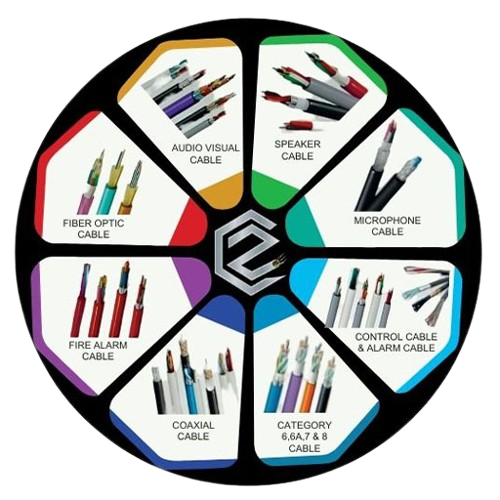
Fire alarm cable is the cable that connects detectors, call points, sounders, beacons and interface modules to a fire alarm control panel. In the UAE, the standards printed on a fire alarm cable decide whether a consultant and Civil Defence will accept it, and those standards test very different things. Some prove the cable will not spread fire along a riser. Others prove the circuit keeps working while it burns. Others limit smoke and toxic gas. This guide explains each family of fire alarm cable standards, what each one proves, and how to read a project specification before you order fire alarm cables in Dubai.
A flame retardant cable resists the spread of flame along its length, but it is not designed to keep a circuit working once fire reaches it. A fire resistant cable, also called a circuit integrity cable, keeps carrying the signal for a stated time while exposed to fire, typically 30, 60 or 120 minutes.
The difference matters because a fire alarm system has to keep sounding the alarm and signalling to the panel while a fire is burning. For that reason many specifications in the UAE ask for fire resistant cable on alarm and voice evacuation circuits, not only flame retardant cable. A datasheet that lists IEC 60332 alone describes a flame retardant cable, because IEC 60332 tests flame propagation, not circuit integrity.
The table groups the standards you will see on fire alarm cable datasheets by what they test.
| Standard or rating | What it tests | What it proves |
|---|---|---|
| IEC 60332-1 and 60332-3 | Flame spread on a single cable and on bunched cables | Flame retardant, not circuit integrity |
| UL 1424 (FPL, FPLR, FPLP) | US power limited fire alarm cable, with FPLR tested for risers and FPLP for plenums | Fire alarm use under NFPA 70 Article 760, flame spread and smoke limits |
| BS EN 50200 (PH30, PH60, PH120) | Circuit integrity under fire, impact and water spray for small cables | Signal keeps working for 30, 60 or 120 minutes |
| BS 7629-1 | Construction of fire resistant cables for fire alarm and emergency lighting | Fire resistant alarm cable, often tested to PH30 or PH120 |
| BS 8434-2 | Fire, impact and water spray for 120 minutes | Enhanced fire resistance for critical circuits |
| BS 6387 (C, W, Z) | Fire alone, fire with water, fire with impact | Circuit integrity under each condition |
| IEC 60331 | Circuit integrity under fire | Fire resistant |
| UL 2196 | Circuit integrity for 1 or 2 hours | US fire resistant (CI) rating |
| IEC 60754 and IEC 61034 | Halogen acid gas and smoke density | Low smoke zero halogen (LSZH) |
A single cable often carries several of these. An enhanced fire resistant alarm cable might list BS 7629-1, BS EN 50200 PH120, BS 8434-2, IEC 60332-1 and IEC 61034 together.
FPLR stands for power limited fire alarm riser cable, a UL 1424 listing used with US fire codes. An FPLR cable has passed a vertical flame test that shows it will not carry fire from floor to floor in a riser shaft. It can be used anywhere FPL cable is allowed, and FPLP plenum cable can replace either.
FPLR is a flame spread rating. It does not on its own prove circuit integrity, which in the US system is shown by a separate UL 2196 CI listing. Cable Zone stocks MAF FA-FPLR 1.5 mm² two core red UL fire alarm cable in 100 metre coils for projects that specify UL listed FPLR cable. Where the specification calls for PH120 or BS 7629 fire resistant cable, choose a cable that carries those ratings on its datasheet.
Low smoke zero halogen cable releases less smoke and no halogen acid gas when it burns, which keeps escape routes visible and reduces corrosive damage to equipment. LSZH is shown by IEC 61034 for smoke density and IEC 60754 for halogen and acid gas content. Most fire resistant alarm cables used in UAE commercial and residential towers have LSZH sheaths, and many consultants require LSZH for all cable in escape routes, basements and enclosed public spaces. PVC sheathed fire alarm cable can still meet flame spread tests, but it will not meet an LSZH requirement.
Start from the project specification and the approved fire alarm system, not from the cable. The specification usually states the circuit integrity level (for example PH120 or BS 8434-2), the sheath (LSZH), the conductor size (commonly 1.0, 1.5 or 2.5 mm²), the core count and the jacket colour, which is red in most UAE projects. The fire alarm panel manufacturer may also list approved cable types and maximum loop lengths.
Then check four things on the cable datasheet. First, that each named standard appears with its test class, not only “complies with BS”. Second, that the conductor size matches the loop calculation. Third, that the sheath is LSZH if required. Fourth, that the manufacturer can supply third party test certificates, because the UAE Fire and Life Safety Code and Civil Defence approval process rely on listed and certified products. Our guide to which cable is used for fire alarm systems covers cable types in more detail, and the control cable vs instrumentation cable guide explains the signal cables that often share the same containment.
Cable Zone Technology supplies fire alarm cable to MEP contractors, fire and life safety companies and maintenance teams from Naif, Deira, with delivery across the UAE. Send your specification or cable schedule and we will match the rating, size and coil length, and share the datasheet before you order. See the range on our fire alarm cable supplier page or request a fire alarm cable quote.
Is FPLR cable fire resistant?
FPLR is a flame spread rating for risers. Fire resistance, meaning the circuit keeps working in a fire, is shown by ratings such as PH120, BS 8434-2, IEC 60331 or UL 2196.
What size is fire alarm cable?
1.5 mm² two core is the most common size for detection loops, with 1.0 mm² and 2.5 mm² used where loop length and current allow or require. The panel manufacturer’s loop calculation decides.
Why is fire alarm cable red?
Red sheaths make fire alarm circuits easy to identify and keep separate from other services, and red is the usual colour in UAE specifications.
Copyright © 2025 Cable Zone | All Rights Reserved. Powered by DEDOTE