Control Cable Sizes: AWG to mm² Conversion and How to Choose Core Count
Control cable size is described by two numbers: the conductor size, given in AWG or mm², and the core count. Together they decide how much current a control circuit can carry, how far it can run before the voltage drops too low, and how many signals one cable can serve. In the UAE, specifications from European consultants usually give sizes in mm², while many control cables on the shelf, including Belden and Ramcro ranges, are sold in AWG. This guide gives an AWG to mm² conversion chart, shows how to check voltage drop, and explains how to choose core count and screening before you buy from a control cable supplier in UAE.
AWG to mm² Conversion Chart for Control Cable
American Wire Gauge numbers run backwards: the smaller the AWG number, the thicker the conductor. Every drop of three AWG sizes roughly doubles the cross section. The chart lists the sizes used in control cable with solid copper values; stranded conductors are close to these figures.
AWG
Cross section (mm²)
Conductor diameter (mm)
Resistance (Ω per km)
Nearest metric size
24
0.205
0.51
84.2
0.22 mm²
22
0.326
0.64
52.9
0.34 mm²
20
0.518
0.81
33.3
0.5 mm²
18
0.823
1.02
20.9
0.75 mm²
16
1.31
1.29
13.2
1.5 mm² is larger, 1.0 mm² is smaller
14
2.08
1.63
8.28
2.5 mm² is larger
12
3.31
2.05
5.21
4.0 mm² is larger
When a specification gives a metric size, choose the AWG size whose cross section is equal or larger. A specification for 0.75 mm² is met by 18 AWG (0.823 mm²), but a specification for 1.0 mm² needs 16 AWG, because 18 AWG is smaller.
How Conductor Size Affects Voltage Drop
Voltage drop is the main reason to choose a larger control cable conductor. Current flows out and back, so the resistance that matters is the loop: twice the run length multiplied by resistance per metre.
Take a 24 V DC actuator drawing 0.5 A at the end of a 100 metre run. On 18 AWG, the loop is 200 metres at 20.9 Ω per km, which is 4.18 Ω, so the drop is 2.09 V, or about 8.7 percent. On 16 AWG, the loop is 2.64 Ω and the drop is 1.32 V, about 5.5 percent. If the device needs at least 21.6 V (24 V minus 10 percent), both work, but 16 AWG leaves margin for a longer run or a second device. Signal only circuits such as BACnet MS/TP, Modbus and KNX draw very little current, which is why 22 AWG and 24 AWG pairs are normal for them.
Choosing Core Count
Choose the core count from the number of conductors each device needs, then add spares. A simple on and off control or a 24 V supply needs two cores. A modulating valve actuator with 0 to 10 V feedback typically needs four. Access control readers, door contacts and lock power together often need six to eight. A spare pair or two in multicore runs costs little and saves a second cable pull if the design changes.
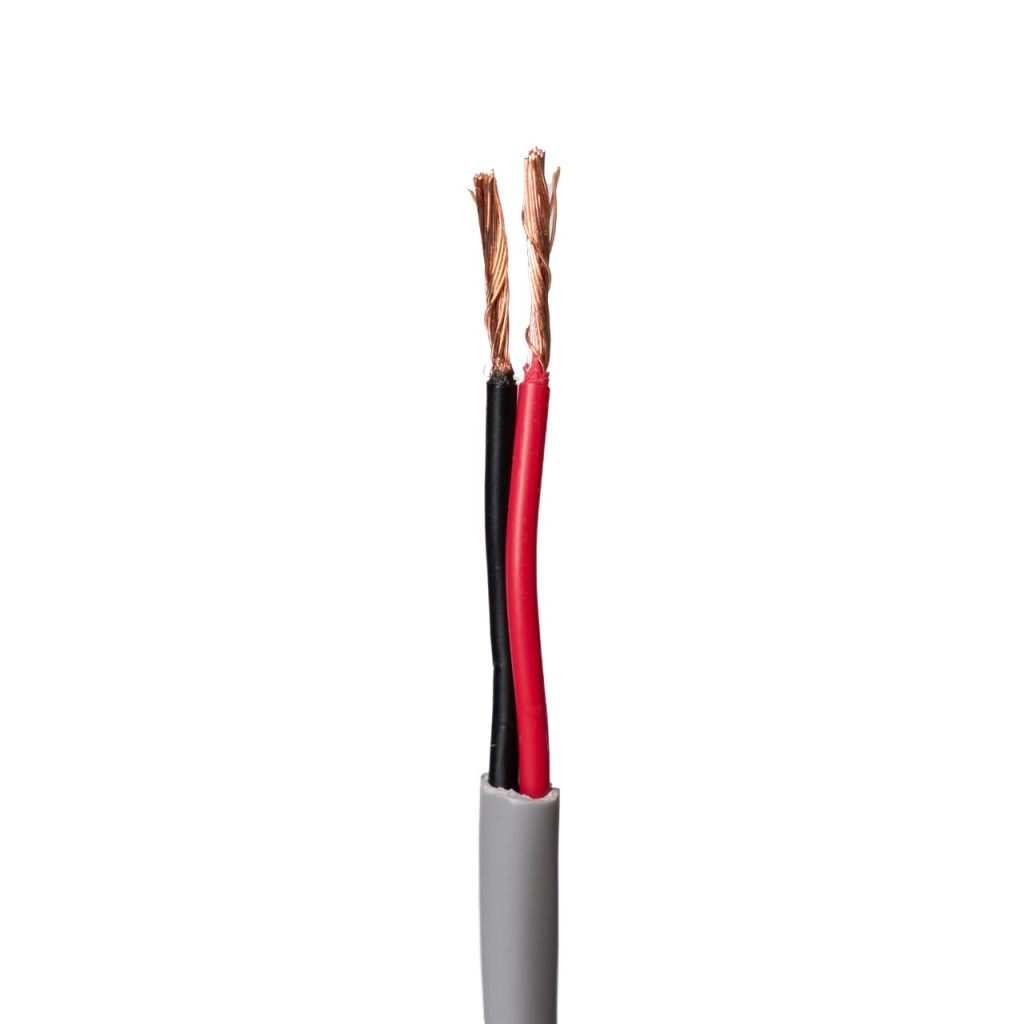
Where several devices sit in the same area, one multicore cable is usually cheaper and neater than several two core runs. Ramcro R1258, for example, is an eight core 18 AWG screened control cable suited to that use, while the CABTON two core range in 16 and 18 AWG covers single point runs. Our CABTON control cable specification guide lists the two core options in detail.
Screened or Unscreened Control Cable?
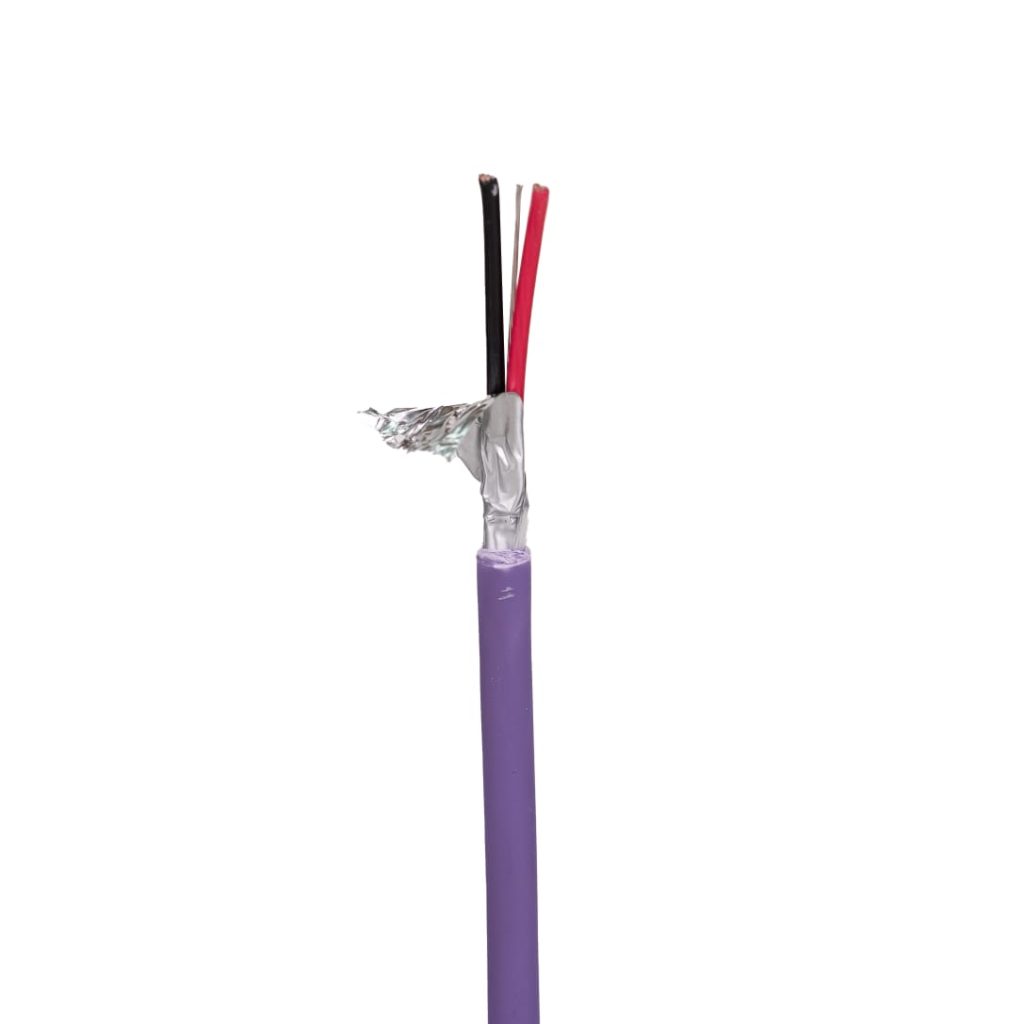
Use screened control cable where the run passes near power cables, variable speed drives, lift motors or fluorescent lighting, and wherever the cable carries an analogue or data signal. The screen, usually aluminium foil with a drain wire, is earthed at one end to drain interference. Unscreened cable is fine for simple switching circuits in clean routes.
Data buses such as RS-485 and BACnet MS/TP need twisted pair cable with a defined impedance, such as Belden 8760 (one pair, 18 AWG, screened), not just any screened multicore. For KNX, use certified KNX bus cable, explained in our KNX cable guide. For process plant signals the right choice is often instrumentation cable, compared in control cable vs instrumentation cable.
PVC or LSZH Sheath
The sheath depends on where the cable runs. PVC sheathed control cable suits plant rooms and industrial areas where the specification allows it. Low smoke zero halogen (LSZH) sheaths are required by many UAE consultants in occupied buildings, escape routes and enclosed public spaces, because they release less smoke and no halogen acid gas in a fire. Check the specification before ordering, since swapping PVC for LSZH after installation means pulling the cable out again.
Control Cable Sizes in Stock at Cable Zone
Cable Zone Technology stocks control cable in the sizes UAE projects use most, including Ramcro 22 AWG and 18 AWG screened and unscreened cables in two to eight cores, Belden 8760 and 5300 series 18 AWG cables, Belden 5200 series 16 AWG cable and CABTON two core 16 and 18 AWG cable, most on 305 metre reels. Send your cable schedule and we will match each line to a stocked size and confirm availability. See the range on our control cable supplier in UAE page or ask for a control cable quote.
Control Cable Size FAQs
Is 18 AWG the same as 0.75 mm²? 18 AWG is 0.823 mm², slightly larger than 0.75 mm², so it meets a 0.75 mm² specification. It does not meet a 1.0 mm² specification.
What size control cable is used for BMS? BMS field wiring commonly uses 18 AWG or 0.75 mm² for power and switching circuits and 22 AWG or 24 AWG twisted pairs for communication buses. The run length and device current decide the final size.
Can I buy less than a full reel? Ask our team about cut lengths for the cable you need. Availability depends on the product and stock at the time.