CABTON control cable is a 2-core unshielded PVC-sheathed cable built for BMS, sound, audio, security, control and instrumentation circuits. It is supplied in two gauges, CZ 5200-2-16UE at 16 AWG and CZ 5300-2-18UE at 18 AWG, both on 305 metre drums. The gauge decision is usually made by habit rather than calculation, and the wrong choice shows up as an actuator that will not drive at the end of a long run. Cable Zone Technology stocks both CABTON gauges in Dubai. This guide gives the full CABTON specification, the voltage drop figures that decide between the two, and the standards both cables are tested against.
What CABTON 2-Core Control Cable Carries in a Building System
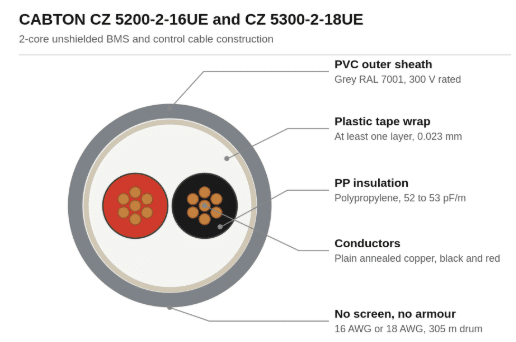
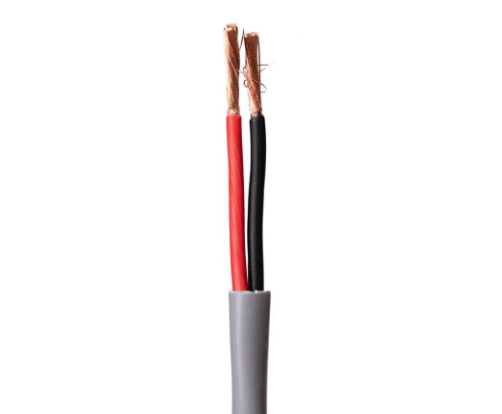
Both CZ 5200-2-16UE and CZ 5300-2-18UE share the same construction apart from gauge. Two polypropylene-insulated cores in black and red, a plastic tape wrap of at least 0.023 mm, and a grey PVC outer sheath to RAL 7001. Neither carries an individual screen, a collective screen, an inner sheath or armour.
The 300 V operating rating sets a hard boundary. These are extra-low-voltage and low-voltage signal cables. They are not mains cables, not a substitute for 450/750 V building wire, and must not feed 230 V loads.
The black and red colour coding gives an unambiguous polarity convention on DC circuits, which removes one of the more common commissioning faults on 24 V actuator and sensor loops. Our control cable supplier in UAE page covers the wider range of core counts and constructions we stock.
CABTON Part Numbers Explained: CZ 5200-2-16UE and CZ 5300-2-18UE
The CABTON part number encodes series, core count, conductor gauge and screening state in that order.
Taking CZ 5200-2-16UE apart: CZ is the CABTON prefix, 5200 is the series designation, -2 is the core count, -16 is the conductor gauge in AWG, and UE denotes the unshielded construction stated in the datasheet header. CZ 5300-2-18UE follows the same pattern in the 5300 series at 18 AWG.
Each cable carries its full identification on the sheath. The 16 AWG prints as CABTON-CZ-5200-2-16UE 2 CONDUCTOR 16 AWG UNSHIELDED PVC AUDIO CONTROL & INSTRUMENTATION CABLE, PVC 300 V 75 C IEC 60332-1, followed by batch number and metre marks from 001M to 305M. The 18 AWG prints the equivalent with FULL COPPER stated.
Two practical benefits come from that sheath print. The sequential metre marking lets an installer read remaining drum length without unwinding, and lets a site engineer confirm an installed run length from the marks at each end. The batch number gives traceability back to the production run if a quality question arises during commissioning, which matters where the consultant requires manufacturer test certificates with the submittal.
Where a submittal proposes an equivalent, the gauge, core count, screening state and insulation material are the four fields that decide whether the substitution is genuinely equivalent to the CABTON cable.
CABTON 16 AWG or 18 AWG: The Voltage Drop Calculation That Decides It
Choose the CABTON gauge by conductor resistance across the actual run length, not by what was used on the last project.
The CABTON datasheets give maximum DC resistance per core at 20°C as 15.47 ohms per kilometre for CZ 5200-2-16UE and 22.7 ohms per kilometre for CZ 5300-2-18UE. On a 2-core circuit current flows out on one core and back on the other, so loop resistance is twice the per-core figure.
The table below gives the resulting voltage drop on a 24 V DC circuit drawing 0.5 A, calculated from those CABTON maximum resistance values.
| Run length | CZ 5300-2-18UE drop | As % of 24 V | CZ 5200-2-16UE drop | As % of 24 V |
|---|---|---|---|---|
| 50 m | 1.14 V | 4.7% | 0.77 V | 3.2% |
| 100 m | 2.27 V | 9.5% | 1.55 V | 6.4% |
| 150 m | 3.41 V | 14.2% | 2.32 V | 9.7% |
| 200 m | 4.54 V | 18.9% | 3.09 V | 12.9% |
Most 24 V field devices tolerate a supply between roughly 21.6 V and 26.4 V, which is 24 V ±10%. Against that limit, the CABTON 18 AWG works to around 100 metres at 0.5 A and becomes marginal beyond it. The 16 AWG holds within 10% out to roughly 150 metres at the same current.
Current scales the drop linearly. A device drawing 1 A halves the workable distance. A device drawing 0.2 A more than doubles it. Calculate against actual device current draw rather than a nominal figure.
Two secondary factors favour the 18 AWG where run length permits. CABTON gives drum weight as 27 kg against 37 kg for the same 305 metres, which affects manual handling and containment loading. The smaller cable also consumes less tray and conduit space where hundreds of field device runs converge on a plant room.
Where CABTON Unshielded Control Cable Is the Right Specification
CABTON unshielded control cable is correct where the circuit carries digital or power signals and the route maintains separation from power cable.
Suitable applications include 24 V DC feeds to actuators and sensors, dry contact and volt-free signalling, on/off and open/close digital commands, door contacts and lock power on access control, and sounder and beacon circuits. These circuits are low impedance, slow, or both, which makes them insensitive to the induced noise a screen would block.
Separation from power cabling is the condition that makes the unshielded specification work. Keep control cable in separate containment from LV power where the building allows. Where they share a route, maintain physical separation along parallel runs and cross at 90 degrees rather than running alongside.
Unshielded construction carries a real advantage beyond cost. A screened cable is only as good as its termination, and a screen landed at both ends creates an earth loop that injects mains-frequency noise into the circuit it was meant to protect. On a large BMS installation with hundreds of field devices and several installers, incorrectly terminated screens are a common and awkward commissioning fault. Where the application does not need a screen, the CABTON unshielded cable removes that failure mode entirely.
When a Run Needs a Screened Cable Instead of CABTON UE
A screened control cable should replace the CABTON unshielded types on analogue instrumentation, serial data, and any run sharing containment with motor or drive cable.
Three situations call for it. 4 to 20 mA analogue loops carry proportional information, so induced noise appears directly as a measurement error on temperature, pressure and flow readings. RS485 and other serial buses operate at frequencies where capacitive and inductive coupling corrupts frames. Routes alongside variable frequency drive output cable face broadband switching noise, among the most aggressive interference sources in any building.
One rule governs screen termination. Land the screen at one end only, normally the panel or controller end, and leave it isolated at the field device. A screen bonded at both ends links two earth points at different potentials and allows circulating current through the screen itself.
Where a route mixes requirements, for example a sensor loop and an actuator feed following the same path, either use a screened cable for both or run them as separate cables. Combining a screened analogue pair and an unscreened switched load in one sheath defeats the purpose of the screen.
Polypropylene Insulation and Capacitance in CABTON Control Cable
CABTON specifies polypropylene core insulation, giving a nominal mutual capacitance of 52 to 53 pF per metre that sets the practical distance limit on serial data runs.
Polypropylene is chosen over PVC for the core insulation because it has a lower dielectric constant and lower dissipation factor. Lower capacitance between cores means less signal rounding on fast edges and less loading on line drivers.
The CABTON figures are 52 pF/m maximum on the 18 AWG and 53 pF/m maximum on the 16 AWG. Over a 200 metre run, 53 pF/m gives roughly 10.6 nF of total capacitance across the pair. That capacitance loads an RS485 driver and slows edge transitions, reducing the maximum reliable data rate as the run lengthens. The relationship is linear: doubling the run doubles the capacitance and halves the usable rate.
On purely resistive circuits, including actuator power and sounder loads, capacitance is irrelevant and the resistance calculation governs. On speaker runs, cable capacitance is negligible against loudspeaker impedance, and gauge choice again comes down to resistance and power loss.
CABTON specifies insulation resistance at a minimum of 1000 megohm-kilometres, with a core-to-core test voltage of 2000 V against the 300 V operating rating. That margin is what allows the cable to sit in shared containment without dielectric breakdown between cores.
Fire Performance Standards on CABTON PVC Control Cable
Both CABTON control cables are tested for flame propagation on single cables to IEC 60332-1 and on bunched cables to IEC 60332-3, with a limiting oxygen index of 30% minimum.
The full CABTON standards set covers smoke density to IEC 61034, halogen acid gas content to IEC 60754-1 at 15% maximum, acidity and conductivity to IEC 60754-2, sunlight resistance to UL 1581 Section 1200, the Low Voltage Directive 2014/35/EU, plus RoHS compliance and ISO 9001 manufacture.
One distinction needs stating plainly, because submittals get rejected over it. The CABTON CZ 5200 and CZ 5300 series are PVC cables, not LSZH cables. The IEC 60754-1 result of 15% maximum halogen acid gas is a reduced-halogen PVC result, where a true low smoke zero halogen cable is specified at 0.5% or less. The bunched flame test to IEC 60332-3 and the 30% limiting oxygen index mean these cables resist flame propagation well, which is a different property from what they emit while burning.
Where the project specification, the consultant or UAE Civil Defence requires LSZH, a PVC cable will not be accepted regardless of flame propagation performance. LSZH is typically mandated on escape routes and in hospitals, airports, metro and tunnel works, and enclosed public assembly areas. Check the specification before ordering. Our fire alarm cables page covers constructions used where fire performance governs.
Installing CABTON Control Cable: Bending Radius, Handling and Temperature
CABTON specifies a minimum bending radius of 8 times the cable diameter on both gauges, and the 16 AWG tolerates roughly 50% more pulling tension than the 18 AWG.
Bending tighter than 8 times the diameter deforms the polypropylene insulation and can displace the tape wrap. On a control cable the electrical consequence is smaller than on a data cable, but a sharp bend at a tray edge or panel gland is a mechanical stress point where the sheath eventually splits.
Pulling tension is the limit most often exceeded on site. A long draw through several bends multiplies tension at the pulling end far beyond what the installer feels at the drum. Use a swivel, use pulling lubricant on long conduit draws, and feed in at the drum rather than pulling the whole length from one end. The 18 AWG has both the lower tension limit and the smaller cross-section, so it is the one that gets damaged.
The CABTON temperature range is -30°C to +80°C for both installation and operation on both gauges, which comfortably covers any UAE plant room, riser, ceiling void or rooftop plant area.
Both cables come on 305 metre put-ups. Plan runs against drum length so field device circuits are unjointed, since every joint in a control circuit is a future intermittent fault.
CABTON CZ 5200-2-16UE and CZ 5300-2-18UE Compared
| Parameter | CABTON CZ 5200-2-16UE | CABTON CZ 5300-2-18UE |
|---|---|---|
| Formation | 2 cores | 2 cores |
| Conductor size | 16 AWG | 18 AWG |
| Conductor | Plain annealed copper, multistrand | Plain annealed copper, 7 strand |
| Insulation | Polypropylene (PP) | Polypropylene (PP) |
| Colour code | Black and red | Black and red |
| Wrapping | Plastic tape, at least 0.023 mm | Plastic tape, at least 0.023 mm |
| Individual screen | None | None |
| Collective screen | None | None |
| Inner sheath | None | None |
| Armour | None | None |
| Outer sheath | PVC, grey RAL 7001 | PVC, grey RAL 7001 |
| DC resistance per core at 20°C | 15.47 ohms/km max | 22.7 ohms/km max |
| Insulation resistance at 20°C | 1000 Mohm-km min | 1000 Mohm-km min |
| Mutual capacitance | 53 pF/m max | 52 pF/m max |
| Inductance | 1 mH/km max | 1 mH/km max |
| Test voltage core to core | 2000 V | 2000 V |
| Operating voltage | 300 V | 300 V |
| Temperature range | -30°C to +80°C | -30°C to +80°C |
| Minimum bending radius | 8 x cable diameter | 8 x cable diameter |
| Weight approx per drum | 37 kg | 27 kg |
| Put-up length | 305 m | 305 m |
| Flame test, single cable | IEC 60332-1 | IEC 60332-1 |
| Flame test, bunched | IEC 60332-3 | IEC 60332-3 |
| Limiting oxygen index | 30% min | 30% min |
| Smoke density | IEC 61034 | IEC 61034 |
| Halogen acid gas | IEC 60754-1, 15% max | IEC 60754-1, 15% max |
| Acidity and conductivity | IEC 60754-2 | IEC 60754-2 |
| Sunlight resistance | UL 1581 Section 1200 | UL 1581 Section 1200 |
| Directive | 2014/35/EU | 2014/35/EU |
Checklist Before Ordering CABTON Control Cable
- List the actual current draw of every device on the circuit, not the nominal rating
- Measure the real route length including risers and drops, not the straight-line distance
- Calculate voltage drop against the CABTON maximum resistance figures, not typical values
- Decide whether the circuit is analogue, serial or digital, which decides screened against CABTON UE
- Check whether the route shares containment with VFD, motor or LV power cable
- Check the project specification for an LSZH requirement before ordering the PVC CABTON types
- Confirm the core count needed, and avoid mixing cable types on one circuit
- Plan run lengths against the 305 m drum so no circuit needs a joint
- Confirm whether the submittal requires the CABTON test certificate and batch traceability
Frequently Asked Questions
What is the difference between CABTON CZ 5200-2-16UE and CZ 5300-2-18UE?
Conductor gauge. CZ 5200-2-16UE is 16 AWG multistrand with 15.47 ohms per kilometre maximum resistance. CZ 5300-2-18UE is 18 AWG 7-strand with 22.7 ohms per kilometre. Construction, insulation, sheath, voltage rating, temperature range and test standards are otherwise identical.
What does 2C mean on CABTON control cable?
2C means two cores, so the cable holds two insulated conductors inside the outer sheath. On both CABTON types those cores are colour coded black and red, giving an unambiguous polarity convention on DC circuits.
Is CABTON 18 AWG enough for a 24 V actuator run?
It depends on run length and current draw. At 0.5 A, a 100 metre run on CZ 5300-2-18UE produces approximately 2.27 V of drop, which is 9.5% of a 24 V supply and sits just inside a typical ±10% device tolerance. Beyond 100 metres at that current, move to CZ 5200-2-16UE.
Is CABTON control cable LSZH?
No. CZ 5200-2-16UE and CZ 5300-2-18UE use a PVC outer sheath and test to IEC 60754-1 at 15% maximum halogen acid gas, where a low smoke zero halogen cable is specified at 0.5% or less. Where LSZH is required by the project or by UAE Civil Defence, specify an LSZH construction instead.
Can CABTON unshielded control cable be used for a 4 to 20 mA loop?
It is not recommended. A 4 to 20 mA signal carries proportional measurement data, so induced noise appears as a false reading rather than a dropped bit. Specify a screened cable for analogue instrumentation and land the screen at the panel end only.
What is the maximum voltage for CABTON control cable?
The operating rating is 300 V with a core-to-core test voltage of 2000 V. Both cables are for extra-low-voltage and low-voltage control and signalling circuits and must not supply mains-voltage loads.
How long is a drum of CABTON control cable?
Both gauges come in 305 metre put-ups, at approximately 37 kg for the 16 AWG and 27 kg for the 18 AWG. The sheath is metre-marked from 001M to 305M so remaining drum length can be read directly.
Where can I buy CABTON cables in the UAE?
Cable Zone Technology supplies CABTON cables from stock in Deira, Dubai, with delivery across Dubai, Abu Dhabi, Sharjah, Ajman, Umm Al Quwain, Ras Al Khaimah and Fujairah. The range includes CABTON 2-core control cable in 16 AWG and 18 AWG, CABTON outdoor CAT6 and CABTON CAT6 indoor cable.
Order CABTON Control Cable From Cable Zone Technology
Cable Zone Technology stocks CABTON CZ 5200-2-16UE and CZ 5300-2-18UE control cable in 305 metre drums in Dubai, with delivery across Dubai, Abu Dhabi, Sharjah, Ras Al Khaimah and the remaining emirates. Send us your cable schedule with run lengths and device current draws, and our team will confirm the gauge for each circuit and issue the CABTON datasheets for your submittal.
Contact Cable Zone Technology for CABTON pricing and project quantities, or call +971 55 418 5686.